
Published: July 25, 2026 · By Sauce SOP
HACCP Plan Guide for Sauce Manufacturers — A Complete Step-by-Step Resource
Every sauce manufacturer in the United States needs a HACCP plan. This guide walks through each of the seven HACCP principles with specific examples for sauce manufacturing.
What is HACCP and why does it matter for sauce manufacturers?
HACCP (Hazard Analysis and Critical Control Points) is a systematic preventive approach to food safety. Instead of testing finished products for contamination, HACCP identifies and controls hazards before they occur. For sauce manufacturers, HACCP is not optional — the FDA requires all food manufacturing facilities to operate under HACCP principles as part of the Food Safety Modernization Act (FSMA).
The 7 Principles of HACCP — Applied to Sauce Manufacturing
Principle 1: Conduct a Hazard Analysis
List every step in your sauce production process. For each step, identify biological hazards (Salmonella, E. coli, Listeria, C. botulinum in low-acid sauces), chemical hazards (pesticides, cleaning residues, allergen cross-contact), and physical hazards (metal, glass, stones, plastic).
Sauce-specific: In hot sauce production, the primary biological hazard is often C. botulinum in low-acid formulations. If your pH is above 4.6, evaluate whether your thermal process achieves commercial sterility.
Principle 2: Determine Critical Control Points (CCPs)
Common CCPs in sauce manufacturing: thermal processing (cooking/pasteurization), pH adjustment (acidification to ≤ 4.6), metal detection after packaging, allergen segregation, and refrigerated storage temperature (≤ 41°F).
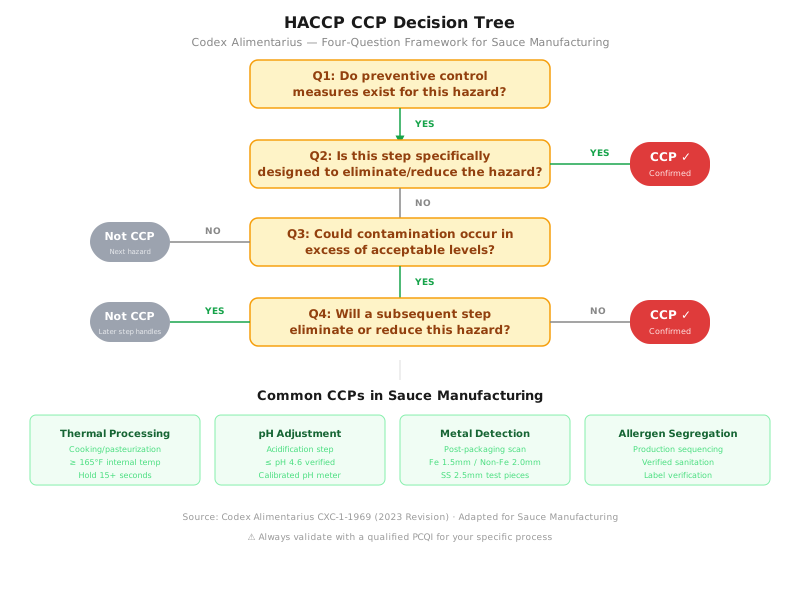
Sauce-specific: For BBQ sauce cooked in a steam-jacketed kettle, the cooking step is almost certainly a CCP — establish minimum internal temperature, minimum hold time, and verification that the entire batch reaches temperature.
Principle 3: Establish Critical Limits
Define measurable limits: minimum internal temperature of 165°F for poultry-based sauces, pH ≤ 4.6 for acidified sauces, water activity ≤ 0.85 for shelf-stable sauces, metal detector sensitivity for 1.5mm ferrous/2.0mm non-ferrous/2.5mm stainless steel test pieces.
Principle 4: Establish Monitoring Procedures
Define what is measured, how it's measured (calibrated instruments), when (frequency), and who (by job title). Example: "The Filling Operator shall measure and record the internal temperature of the first three containers filled from each batch, using Calibrated Thermometer #T-042. Temperature must be ≥ 185°F. Record on Form CCP-01."
Principle 5: Establish Corrective Actions
What happens when a critical limit is not met? Identify and hold affected product, determine root cause, decide disposition (reprocess/destroy/release), prevent recurrence. Document every deviation.
Principle 6: Establish Verification Procedures
Calibration schedules, record review (supervisor reviews CCP records within 7 days), annual HACCP plan reassessment, periodic product testing, third-party audits.
Principle 7: Establish Record-Keeping and Documentation
If it isn't documented, it didn't happen. Maintain the master HACCP plan, daily monitoring logs, corrective action records, calibration logs, training records. Keep records for at least 2 years.
Common HACCP Mistakes Sauce Manufacturers Make
- Too many CCPs: A good HACCP plan typically has 2-5 CCPs. Use prerequisite programs for everything that isn't a true CCP.
- Vague critical limits: "Cook thoroughly" is not a critical limit. "165°F internal temperature for 15 seconds" is.
- Ignoring pH in fermented sauces: If fermented hot sauce doesn't reach pH ≤ 4.6 consistently, you have a pathogen risk.
- No re-assessment after changes: Re-assess your hazard analysis every time you change ingredients, equipment, or processes.
Ready to build your HACCP documentation?
Sauce SOP generates the full HACCP-aligned SOP structure — tailored to your sauce type, process, and equipment — in minutes, not weeks.
Start free — 3 AI SOPs included